There are cameras that belong to a particular period, and there are cameras that seem to exist outside time. The Leica M belongs to the latter category.
Put a Leica M3 from 1954 beside a modern digital M11 and the family resemblance is unmistakable. The materials have changed. Film has become a sensor. Electronics have entered a camera that was once almost entirely mechanical. Yet the essential idea remains remarkably intact: a compact body, a rangefinder, interchangeable lenses, manual focusing and as little as possible between the photographer and the photograph.
The history of the Leica M, however, does not begin with the M3. It begins decades earlier, with an engineer in Wetzlar named Oskar Barnack and an idea that would fundamentally change photography.
Wetzlar, Leitz and Oskar Barnack
Long before Leica became synonymous with cameras, the company behind it was known for optical instruments.
In 1849, Carl Kellner founded an optical institute in Wetzlar, Germany. Ernst Leitz joined the company in 1864 and took control of it shortly afterwards. Under Leitz, the business developed into an internationally important manufacturer of microscopes and precision optical equipment.
It was into this world of precision mechanics and optics that Oskar Barnack arrived in 1911.
Barnack was a precision mechanic and engineer who worked on cinema and measuring equipment. He was also an enthusiastic photographer. Photography in the early twentieth century generally meant large cameras, glass plates or large sheets of film, tripods and considerable weight.
Barnack wanted something different.
Partly because he suffered from asthma and found heavy photographic equipment difficult to carry, he began experimenting with the idea of a much smaller camera. His crucial insight was to use 35mm motion-picture film for still photography.
Cinema film normally travelled vertically through a movie camera. Barnack turned the film sideways and used an image area of approximately 24 × 36mm.
The result, developed around 1913–1914, became known as the Ur-Leica.
It was a deceptively simple idea: use a small negative and compensate for its size through excellent optics and sufficient enlargement.
That principle would help define photography for the rest of the twentieth century.
“We will take the risk”
Barnack had created the concept, but turning it into a commercial product was another matter.
The First World War delayed development, and even afterwards there were doubts within Leitz about whether photographers would accept such a small negative. Compared with the large photographic formats of the period, 24 × 36mm seemed almost absurdly small.
Producing the camera commercially represented a significant financial risk.
The decisive figure was Ernst Leitz II.
In 1924, after considerable internal discussion, Leitz made the decision to proceed. Leica records the famous statement attributed to him:
“I hereby decide: we will take the risk.”
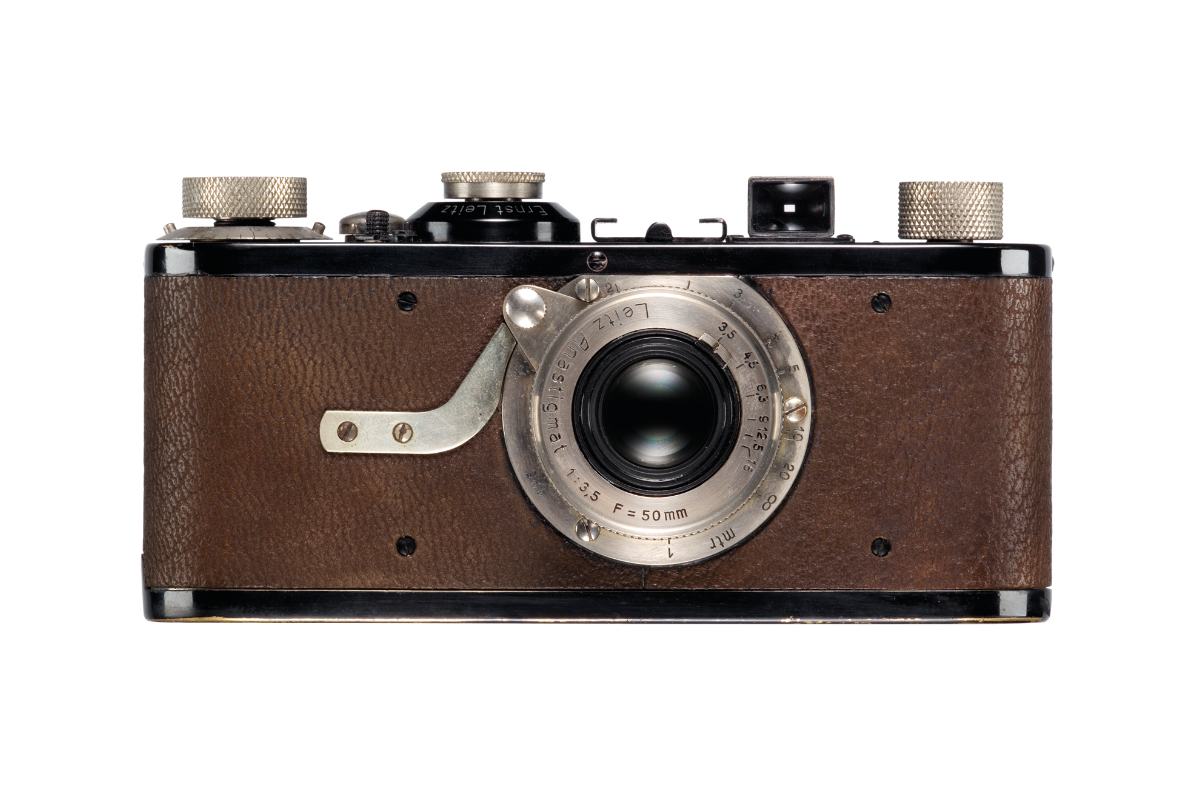
Production began, and in March 1925 the Leica I was presented at the Leipzig Spring Fair.
The name itself came from Leitz Camera: Lei-ca.
The little camera transformed photography. Instead of setting up a tripod and arranging a scene, photographers could walk through streets with a camera in their hands, respond quickly and photograph life as it happened.
Photography became more mobile, spontaneous and discreet.
The Leica I helped establish the 24 × 36mm frame as the standard we still call 35mm or full frame today.
Before the M: the screw-mount Leicas
The Leica M did not appear until 1954. During the preceding decades, Leitz continually refined Barnack’s original concept.
Early Leica cameras used lenses attached by a threaded mount, eventually standardised around what became known as the Leica Thread Mount, or LTM.
Models such as the Leica II and III introduced increasingly sophisticated features, including a coupled rangefinder and broader shutter-speed ranges. Interchangeable lenses turned the Leica from a small camera into a photographic system.
That distinction was important.
A Leica was no longer simply a camera with a lens. The photographer could choose lenses for different purposes while keeping the same compact body.
Wide-angle lenses made street and architectural photography possible without cumbersome equipment. A 50mm became the natural standard lens. Longer lenses extended the system into portraiture and reportage.
By the 1930s, Leica photography had become closely associated with photojournalism and what would later be called street photography.
The camera encouraged photographers to move.
That characteristic would survive every subsequent generation of Leica.
1954: the Leica M3
The great break with the Barnack-style Leica came in 1954.
At Photokina, Leitz introduced the Leica M3.
The letter M referred to Messsucher — the German term for a combined rangefinder/viewfinder system.
The M3 represented an extraordinary redesign. Instead of screwing lenses onto the camera, photographers could now attach them quickly using the new Leica M bayonet mount. Film transport was faster. The body was more substantial. Most importantly, the camera introduced a large, bright combined rangefinder and viewfinder with automatically displayed frame lines.
For photographers accustomed to separate viewing and focusing arrangements, it was a major advance.
The photographer looked through the finder, aligned two images in the rangefinder patch, composed within the illuminated frame lines and pressed the shutter.
Nothing more was necessary.
That simplicity became the foundation of the M philosophy.
The M3 was particularly well suited to the 50mm lens, while also providing frame lines for 90mm and 135mm lenses. Its high viewfinder magnification made focusing exceptionally precise.
The basic mechanical architecture proved so successful that the Leica M cameras made seventy years later remain recognisably descendants of the M3.
M2: a wider view
In 1957 Leica introduced the M2.
At first glance it looked very similar to the M3, but there was an important difference. The viewfinder had lower magnification and included 35mm frame lines.
This made the M2 particularly attractive to photographers working with wider lenses.
The distinction between the M3 and M2 therefore reflected two different approaches to photography. The M3 was exceptionally comfortable with a 50mm lens; the M2 made the increasingly popular 35mm focal length feel natural.
That combination — an M2 with a 35mm lens — became one of the classic configurations in documentary and street photography.
It also demonstrated something fundamental about the M system: the viewfinder and the lens were designed to work together as part of a photographic experience.
M4: refinement of the mechanical M
The Leica M4, introduced in 1967, refined the design rather than reinventing it.
A faster film-loading system, improved rewind mechanism and ergonomic changes made the camera quicker to operate. Many photographers regard the M4 as one of the finest expressions of the purely mechanical Leica M.
It represented an era in which virtually every important operation remained under the photographer’s direct control.
Focus the lens.
Choose the aperture.
Set the shutter speed.
Frame.
Release the shutter.
Photography reduced to essentials.
M5: the controversial Leica
In 1971 came one of the most unusual cameras in Leica history: the M5.
Leica incorporated through-the-lens metering into an M camera, but doing so required a substantially redesigned body. The M5 was larger and visually quite different from the traditional M shape.
Technically, it was sophisticated. Commercially, it struggled.
The reaction revealed something important about Leica photographers: they did not merely want rangefinder technology. They had become attached to the form and handling philosophy established by the M3.
The lesson would influence later M cameras.
Innovation was welcome — but preferably without destroying the character of the camera.
M6: the modern mechanical classic
The Leica M6, introduced in 1984, found a much more successful balance.
Externally, it returned to the familiar proportions of earlier M cameras. Internally, however, it incorporated through-the-lens exposure metering.
This created an elegant compromise.
The shutter remained mechanical. The photographer still focused manually and selected shutter speed and aperture manually. Electronics assisted with exposure measurement rather than taking control of the photographic process.
For many photographers, that was exactly enough technology.
The M6 consequently became one of the most celebrated Leica cameras ever produced. Its reputation became so strong that Leica eventually reintroduced the M6 in a modern production version.
The enduring appeal is easy to understand: the M6 provides modern metering while retaining the tactile experience of a traditional mechanical rangefinder.
M7 and MP: two directions
In 2002 Leica introduced two cameras representing different interpretations of the M tradition.
The M7 brought electronically controlled shutter speeds and aperture-priority automatic exposure to the system. For photographers working quickly, this could be extremely useful.
The Leica MP, by contrast, emphasised mechanical simplicity.
Its philosophy was closer to the classic M cameras: minimal electronics, traditional operation and a mechanical shutter.
The two cameras illustrated a debate that continues among Leica photographers today.
How much technology should stand between photographer and image?
There is no universal answer. The M7 offered speed and convenience. The MP offered independence and simplicity.
Both remained unmistakably Leica.
The lenses: the other half of the Leica story
The history of the Leica M cannot be separated from the history of Leica optics.
A rangefinder body is ultimately only half a system. Much of Leica’s reputation was built by the lenses mounted on its cameras.
Names such as Elmar, Summaron, Summicron, Summilux and Noctilux became part of the vocabulary of photography.
The names also indicate something about Leica’s optical hierarchy.
An Elmar traditionally represents a relatively compact lens with a moderate maximum aperture.
A Summicron generally has a maximum aperture of f/2 and became one of the defining Leica lens families.
A Summilux offers f/1.4, providing greater low-light capability and shallower depth of field.
The Noctilux name became associated with extremely fast lenses designed for photography in very low light.
But Leica lenses are interesting for more than sharpness or aperture.
Different generations have different optical signatures.
Older lenses may show lower contrast, more flare and gentler transitions. Later lenses often provide higher contrast, improved correction and greater performance at maximum aperture.
This means that choosing a Leica lens is not necessarily a question of finding the objectively “best” lens.
A photographer may deliberately prefer an older Summicron because of the way it renders light, faces or tonal transitions.
The imperfections can become part of the photograph.
From film to digital: the M8
Digital photography presented Leica with a serious problem.
How could the company transform the M into a digital camera without turning it into something fundamentally different?
The first answer arrived in 2006 with the Leica M8.
It retained the rangefinder, M bayonet and familiar manual focusing, but replaced film with a digital sensor. Because its sensor was smaller than a 35mm frame, however, the M8 had a crop factor of approximately 1.33×.
It was therefore digital, but not yet the complete digital equivalent of a 35mm Leica M.
That would come three years later.
M9: the digital M comes of age
The Leica M9, introduced in 2009, was a landmark.
It was the world’s first digital full-frame rangefinder camera, using a sensor approximately the same size as the traditional 24 × 36mm film frame.
For the first time, classic M lenses behaved digitally much as photographers expected them to behave on film.
A 35mm remained a 35mm.
A 50mm remained a 50mm.
The historical relationship between lens, frame lines and field of view had been restored.
Perhaps more importantly, the M9 demonstrated that digital photography did not necessarily require autofocus, electronic viewfinders and complex automation.
The photographer could still focus manually through an optical rangefinder.
Digital technology had entered the Leica M, but the essential method of photography had survived.
M240, M10 and M11
The digital M continued to evolve.
The Leica M (Typ 240) introduced a CMOS sensor and features such as live view, expanding the camera’s possibilities beyond traditional rangefinder operation.
The M10, introduced in 2017, moved back toward the physical proportions and operational simplicity associated with film M cameras. It was slimmer than its digital predecessors and placed greater emphasis on the essential controls.
Then came the M11.
Its high-resolution full-frame sensor, modern electronics and digital workflow would have been unimaginable to Oskar Barnack. Yet place an M11 beside an M3 and the lineage is immediately visible.
The M11 still uses the M bayonet.
It still uses manual-focus lenses.
It still employs an optical rangefinder.
And the photographer still sees the world through a window rather than through the taking lens.
Leica describes the M11’s sensor as offering selectable resolutions of 60, 36 and 18 megapixels — an extraordinary technical distance from Barnack’s strip of cinema film, yet philosophically the two cameras remain related.
Why the Leica M survived
The most remarkable thing about the Leica M may not be any particular model.
It is the continuity.
Most camera systems disappear when technology changes. Lens mounts are abandoned. Electronic standards become obsolete. New generations replace old ones completely.
The Leica M mount introduced in 1954 remains alive.
A photographer can take a lens made decades ago and, with the appropriate compatibility considerations, use it on a modern digital Leica M. Conversely, the fundamental act of photographing with an M3, M6 or M11 remains surprisingly similar.
This continuity exists because Leica has rarely tried to make the M into a camera for everyone.
A rangefinder has limitations.
Long telephoto lenses are awkward. Extreme close-up photography is difficult. Manual focusing requires practice. The photographer does not see depth of field through the viewfinder. Modern autofocus cameras can operate far faster.
But those limitations define the M as much as its strengths do.
The M encourages anticipation rather than reaction.
You learn distances.
You begin to pre-focus.
You watch what happens outside the frame lines.
You decide where to stand rather than immediately reaching for a zoom ring.
And because the camera does relatively little for you, photography becomes a sequence of deliberate decisions.
From Barnack’s idea to a photographic philosophy
Oskar Barnack could not have foreseen digital sensors, memory cards or sixty-megapixel files when he began experimenting in Wetzlar more than a century ago.
But he might recognise the intention behind the modern Leica M.
His original problem was not simply how to make a smaller camera.
It was how to free the photographer from the camera.
The camera had to become light enough to carry, fast enough to use spontaneously and precise enough that its small negative could produce excellent photographs.
Ernst Leitz II understood the potential and accepted the commercial risk.
The Leica I turned the idea into a product.
The M3 transformed it into a system.
And successive generations — M2, M4, M5, M6, M7, MP, M8, M9, M10 and M11 — have repeatedly interpreted the same principle for their own time.
That may be the real reason the Leica M remains relevant.
Its history is not simply a progression from old technology to new technology.
It is the history of an idea:
make the camera small, make the optics excellent, remove what is unnecessary — and leave the photograph to the photographer.
More than a century after Barnack began working on his little camera in Wetzlar, that idea still feels remarkably modern.
And every time an M photographer raises the viewfinder to an eye, turns the focusing ring until two images coincide, waits for the moment and presses the shutter, a small part of that history continues.