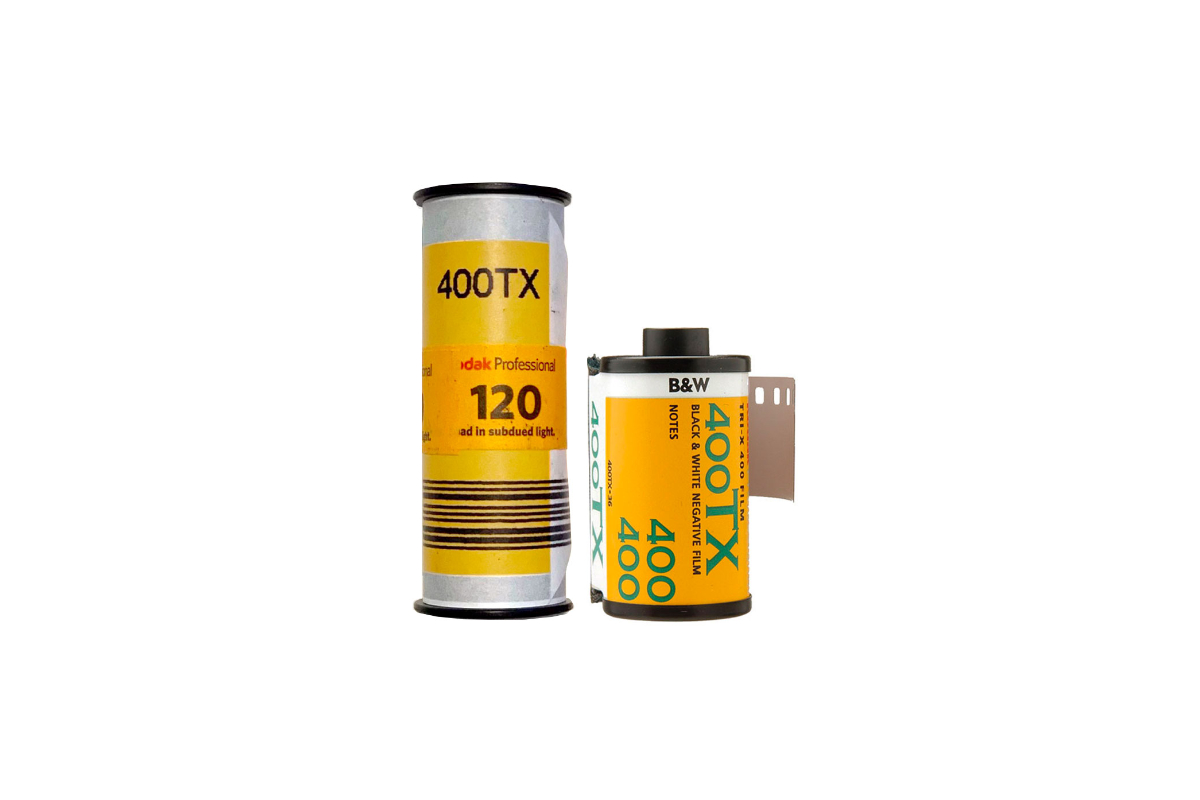
There is something reassuring about Kodak Tri-X 400. It is not a film that demands perfect exposure. On the contrary, part of its character lies in what happens when exposure is less than perfect.
For generations of photographers, Tri-X has been associated with available light, documentary photography, photojournalism and the freedom to work quickly. It has been pushed when the light disappeared, overexposed when circumstances demanded it, developed in countless combinations of developers, temperatures and times, and printed in darkrooms all over the world. Through all of this, it acquired a reputation for being forgiving.
But forgiving is an imprecise word.
What we are really talking about is exposure latitude: the range of exposures over which a film can produce a useful negative. And with Tri-X, latitude is more interesting than simply having some protection against an inaccurate meter reading. It is one of the characteristics that allows the photographer to decide how the negative should behave.
Latitude is not merely tolerance.
It is creative space.
What Exposure Latitude Actually Means
A light meter gives us an exposure. Perhaps 1/250 second at f/8. The numbers have an authority about them that makes it tempting to regard this combination as the correct exposure.
Film is less absolute.
The meter does not know what part of the scene matters to us. It does not know whether the shadows should contain texture or disappear into black. It does not know whether a bright wall should retain subtle tonal differences or approach white. It simply measures light according to the way it was designed to measure it.
The negative responds differently.
Photographic film does not suddenly stop working when exposure moves away from the meter’s recommendation. Instead, density changes continuously as the amount of light reaching the emulsion changes. Within a surprisingly broad range, useful tonal information can still be recorded.
That range is the practical exposure latitude of the film.
Tri-X is particularly tolerant of additional exposure. Give it more light and the negative becomes denser, but highlights do not immediately become unusable. This is one reason black-and-white negative film can be remarkably forgiving of overexposure.
Underexposure is another matter.
Once important shadow areas receive too little light to produce meaningful density in the negative, the information simply is not there. Development can increase contrast, but it cannot manufacture detail that was never recorded.
This asymmetry — generous tolerance toward overexposure and much less tolerance toward underexposure — is fundamental to understanding Tri-X.
Tri-X at 400
Kodak rates Tri-X at ISO 400, and there is nothing mysterious about using it that way.
At its nominal speed, Tri-X offers the combination that made it famous: useful sensitivity, distinct but attractive grain, strong tonal separation and enough exposure flexibility for rapidly changing conditions.
In normal daylight, ISO 400 is fast enough to permit handheld photography with relatively small apertures and useful shutter speeds. Indoors or toward evening, it remains workable with a fast lens. That versatility was enormously important before photographers could change ISO from frame to frame.
Put a roll of Tri-X in a camera and you have committed yourself to the same emulsion for 36 exposures.
That sounds restrictive from a digital perspective.
In practice, it can be liberating.
Instead of constantly changing sensitivity, the photographer learns to work with the light that is available. Aperture, shutter speed, subject movement and exposure become interconnected decisions rather than settings selected independently.
And because Tri-X has latitude, those decisions do not have to be perfect to the fraction of a stop.
Giving Tri-X More Light
Many photographers expose Tri-X at an exposure index lower than 400. Rating it at EI 200, for example, gives the film one additional stop of exposure.
Why deliberately overexpose a perfectly good ISO 400 film?
The answer is largely in the shadows.
Shadow areas contain relatively little exposure to begin with. Giving the film more light moves those darker tones farther into the region where the emulsion records useful density. Texture that might have been barely visible at EI 400 can become more clearly separated.
The result can be a negative with generous shadow information and considerable tonal flexibility.
This does not mean that EI 200 is somehow the “true” speed of Tri-X, nor that everyone should expose it that way. Film speed, developer, development technique, meter calibration, enlarger or scanner and personal preference all interact.
But it demonstrates something important.
Changing exposure changes the negative before development ever begins.
If shadow detail matters, exposure is your primary tool.
The Other Direction: Tri-X at 800
Now turn the dial the other way.
Set the meter to ISO 800 while leaving Tri-X in the camera and each frame receives one stop less exposure than it would at ISO 400.
The film itself has not changed.
It has not suddenly become an ISO 800 emulsion simply because the number on the meter changed. You are underexposing ISO 400 film by one stop.
This distinction is central to understanding pushing.
When Tri-X is subsequently given increased development, midtones and highlights can be raised to produce a negative that prints or scans with greater apparent brightness and contrast. But the weakest shadow exposures cannot be fully restored. If too few photons reached those parts of the emulsion, there is nothing for longer development to recover.
That is why pushed photographs often have a characteristic appearance: stronger contrast, more obvious grain and shadows that can become deep or empty.
Sometimes this is considered a technical compromise.
Sometimes it is precisely the picture we want.
Pushing Is Not Increased Sensitivity
The language of film photography can make pushing sound almost magical.
“Tri-X pushed to 1600.”
The phrase suggests that development has transformed a 400-speed film into a 1600-speed film.
It has not.
If Tri-X is metered at EI 1600, it receives two stops less exposure than it would at 400. Push development compensates primarily by increasing the density and contrast of the parts of the negative that received sufficient exposure.
This is extremely useful. It allows photographers to work in light that would otherwise require shutter speeds too slow to handhold or apertures wider than their lenses provide.
But it comes with consequences.
Shadow information is sacrificed. Contrast generally increases. Grain may become more prominent. The tonal relationships within the scene change.
Those consequences are not necessarily defects.
The mistake is to regard pushing merely as a technical rescue operation. Once understood, it becomes another aesthetic choice.
A photograph made on Tri-X at 1600 does not have to imitate one made at 400.
Why should it?
Latitude and the Zone System
Exposure latitude becomes easier to understand when we stop thinking only about average meter readings and begin thinking about where individual tones fall.
This was one of the great insights behind the Zone System associated with Ansel Adams and Fred Archer.
A meter can tell us how much light is reflected from a surface. The photographer decides how that surface should appear in the finished photograph.
Suppose a dark coat contains texture that is important to the picture. If we allow that coat to fall too far below the exposure needed to record useful shadow detail, no amount of careful printing will fully restore it.
Exposure determines whether that information reaches the negative.
At the opposite end, development has a powerful influence on how highlight densities build.
This leads to the classic black-and-white principle:
Expose for the shadows, develop for the highlights.
It is an old phrase, but Tri-X makes its logic wonderfully visible.
Its latitude gives us room to position the darker values with exposure while controlling the higher densities through development, printing or scanning.
The negative becomes something shaped rather than merely captured.
What the Scanner Changes
Most Tri-X photographs today will never enter a traditional darkroom. The negatives will be scanned, either with a dedicated film scanner, a camera-based digitizing setup or by a laboratory.
This changes the workflow, but not the physics of exposure.
A scanner can extract an impressive amount of information from a dense negative. Highlights that initially appear almost impenetrable may contain substantial detail. Digital processing can then adjust curves, contrast and local tonal relationships with precision that darkroom printers could only achieve through careful burning, dodging and paper selection.
This can make overexposure seem almost harmless.
It is not unlimited.
At some point, excessive negative density becomes difficult to scan efficiently. Grain, flare and scanner limitations can become relevant. But in practical photography, a moderately overexposed Tri-X negative is often easier to work with than a severely underexposed one.
Again, the reason is simple.
The dense negative contains information.
The thin shadow does not.
Latitude Is Not an Excuse for Carelessness
Because Tri-X is forgiving, it is tempting to conclude that precise exposure does not matter.
The opposite is more useful.
Latitude becomes most valuable when you know it exists and decide how to use it.
There is a difference between accidentally overexposing a frame by a stop and deliberately giving a shadow an additional stop because you want texture there.
The negative may receive the same amount of light in both cases.
The photographic decision is entirely different.
Understanding latitude therefore does not make metering less important. It makes metering more meaningful.
Instead of asking only:
What exposure does the meter recommend?
we can ask:
What do I want this part of the photograph to look like?
That is a much more interesting question.
One Film, Many Negatives
Imagine photographing the same scene on Tri-X several times.
One frame is exposed at EI 200.
Another at 400.
Another at 800.
Another at 1600, followed by appropriate push development.
They may all produce recognizable and printable photographs, but they will not produce the same photograph.
Shadow separation changes. Grain changes. Contrast changes. Highlight density changes. The emotional weight of the image may change with them.
The EI 200 negative might feel open and generous, with information extending deeply into the darker tones.
At 400, the photograph may have the familiar balance associated with Tri-X.
At 800 or 1600, the shadows may close, grain may become more assertive and the tonal structure may become harder and more graphic.
Which one is correct?
That depends on what you were trying to say.
The Digital Habit
Digital photography has changed the way we think about exposure.
We watch histograms. We enable highlight warnings. We inspect images at 100 percent. Modern sensors offer extraordinary dynamic range, and raw processing allows remarkable recovery from exposures that once would have been considered problematic.
These are genuine advances.
But they can also encourage the idea that the objective of exposure is to preserve as much information as technically possible.
Film offers another perspective.
A negative does not have to contain every possible tone in order to be successful. A shadow can be allowed to become black. A highlight can approach white. Grain does not have to be removed. Contrast does not always have to be controlled.
The limits of the material can become part of the photograph.
Tri-X is particularly good at teaching this because its latitude is broad enough to forgive experimentation while its character is strong enough to reveal the consequences.
You can see what exposure does.
Learning a Film
Perhaps the greatest advantage of working repeatedly with the same film is not consistency but familiarity.
After enough rolls of Tri-X, numbers begin to acquire visual meaning.
ISO 400 is no longer simply the number printed on the box.
You begin to know what happens when you give the film another stop. You recognize the kind of shadows you get when you expose at 800. You learn how your preferred developer changes contrast. You discover how dense a negative your scanner can comfortably handle.
Eventually, you may meter less anxiously.
Not because exposure has become unimportant, but because you understand the material well enough to anticipate what it will do.
That knowledge cannot be obtained entirely from data sheets, exposure tables or online recommendations.
It comes from negatives.
Preferably your own.
Latitude as Freedom
There is a tendency in photography to search for correct settings.
The correct ISO.
The correct developer.
The correct exposure.
The correct development time.
Technical consistency is valuable, particularly when we are trying to understand a material. But photography becomes more interesting when technique stops being a set of rules and becomes a vocabulary.
Tri-X has survived successive generations of cameras, meters, developers, enlargers, scanners and photographers because it offers something beyond nominal speed.
It accommodates interpretation.
Its latitude gives the photographer room to make mistakes, certainly. But more importantly, it gives room to make decisions.
We can give the shadows more light.
We can let them disappear.
We can develop gently.
We can push aggressively.
We can seek a long scale of greys or reduce the world to harder divisions of black and white.
The emulsion does not insist on a single answer.
Perhaps that is the real meaning of exposure latitude. Not the number of stops by which we can miss a meter reading and still rescue the photograph, but the distance within which we can move deliberately and still create a negative that says what we intended.
Tri-X is forgiving.
Sometimes latitude is just another word for freedom.