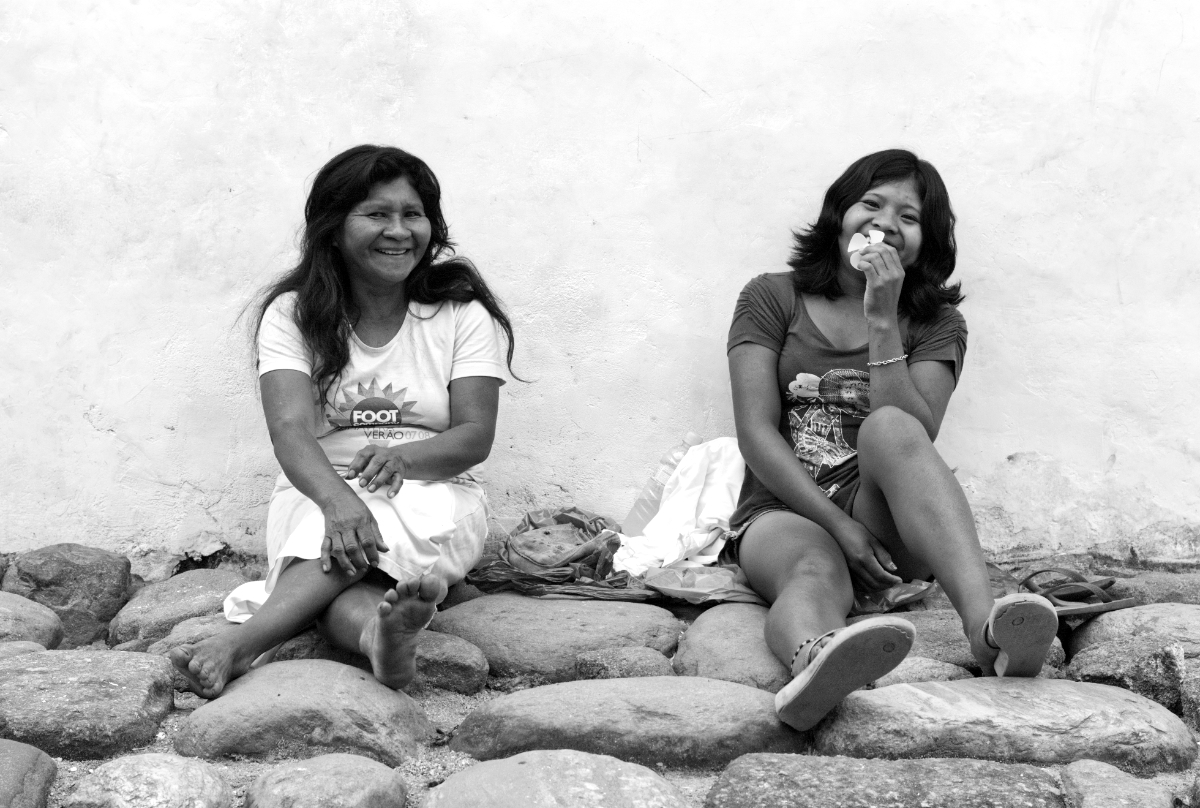
For me, street photography begins with something remarkably simple: life happening in front of my camera.
A man waits alone at a bus stop. Two strangers exchange a glance while passing each other. A child runs through a patch of sunlight. Someone disappears around a corner just as another person enters the frame. Late-afternoon light falls between buildings and divides the pavement into areas of brightness and darkness.
Nothing has been arranged. Nobody has been told where to stand. There may be no event of any importance taking place at all.
And yet, for a fraction of a second, everything comes together.
That is what street photography means to me.
I do not think street photography has to document news or extraordinary events. I am interested in life as it presents itself at that particular moment. Sometimes that means people. Sometimes it is an interaction between strangers, a gesture or an expression. At other times, the people themselves are almost secondary and what catches my attention is the light, a shadow, a reflection or the way several unrelated elements suddenly form a composition.
The street provides the material.
My task is to recognise the photograph within it.
What Street Photography Means to Me
The word street can be misleading. I do not believe street photography literally requires a street.
I can find it in a railway station, café, market, park, shopping centre, beach, airport or almost any other public environment where life unfolds without being directed by me. What matters is not so much where I am standing, but how I respond to what is happening around me.
For me, street photography is about observing the world as it presents itself.
That distinguishes it from many other forms of photography. In a studio, I can position my subject, change the lighting and reconsider the composition. On the street, I have very little control. People move. Light changes. Cars appear. Someone suddenly walks into my frame. A gesture may last less than a second.
I find precisely this lack of control fascinating.
I have to work with uncertainty.
Sometimes a person catches my attention first. On other occasions, the photograph begins with the environment. I may notice a shaft of sunlight falling across a wall and immediately see the potential for a photograph. But something is missing.
So I wait.
Someone eventually enters that patch of light.
Perhaps the first person is in the wrong position. The second disappears too quickly. Then another person enters the scene and, for one brief instant, the figure, light, shadow and surrounding architecture fall into place.
That is the moment I am looking for.
It is also why I do not consider every photograph of a person in a public place to be street photography. Simply pointing a camera at pedestrians is not enough for me.
Something has to happen within the frame.
That something does not have to be spectacular. In fact, it usually is not.
It can be a glance between two people. A repetition of shapes. A contradiction between an advertising poster and the person walking underneath it. A reflection in a shop window. A shadow transforming an otherwise ordinary scene. Several people whose positions, purely by coincidence, suddenly create a balanced composition.
These moments are everywhere.
The difficulty is seeing them.
My Mindset on the Street
The most important piece of equipment I carry is not my camera.
It is my attention.
When I photograph on the street, I try to make myself receptive to what is happening around me. I watch where the light falls. I look at backgrounds. I notice how people move through a particular space and try to anticipate where they might be a few seconds later.
I am not only looking at what is happening.
I am constantly wondering what might happen.
That distinction has become increasingly important to me.
Sometimes I find the stage before I find the subject. There may be a wall divided diagonally by sunlight and shadow, a staircase with repeating lines, a doorway surrounded by darkness or an advertisement creating a strong block of colour.
The composition is almost there.
Now I need someone to enter it.
So I wait.
This requires patience, but it also requires restraint. With a digital camera, it is easy to make hundreds of exposures simply because there is no immediate cost attached to pressing the shutter. But I do not want to photograph everything that moves.
I want to recognise the moment when the separate elements become a photograph.
That also means accepting failure.
I can walk for hours and return with hundreds of exposures but perhaps only one photograph that really matters to me. Sometimes I return without even that one.
I do not regard such a day as wasted.
Walking, watching and anticipating are themselves part of the process. The more I observe, the more sensitive I become to small changes in gesture, distance, light and composition.
Street photography teaches me patience because the photograph cannot be forced.
I can place myself in a promising situation.
I can prepare.
I can watch.
But ultimately, life has to provide the moment.
The Camera I Carry
I do not believe there is such a thing as the perfect street-photography camera.
Almost any camera can be used successfully. What matters to me is that it does not become an obstacle between myself and what I am observing.
I prefer a camera that is relatively small, discreet and simple to operate. I want to be able to carry it for hours without thinking about its weight. More importantly, I want its controls to become instinctive.
The less attention I have to give the camera, the more attention I can give to the street.
This explains why rangefinder cameras have such a strong historical association with street photography. A Leica M with a small prime lens, for example, is compact and relatively unobtrusive. But owning a Leica does not make anyone a street photographer, just as using the same paintbrush as a famous painter will not produce the same paintings.
The camera records the photograph.
It does not recognise it.
That remains my job.
My Choice of Lens
For street photography, I find the traditional focal lengths of 28mm, 35mm and 50mm particularly interesting because each encourages a different relationship with the subject.
A 28mm lens brings me physically close. It includes a great deal of the surroundings and can create photographs with considerable energy and depth. But it also demands confidence. If I want a person to have a meaningful presence within the frame, I usually need to get quite close.
A 35mm lens provides more balance between subject and environment. It allows me to include context without making the surroundings dominate the photograph. I understand why it has become such a classic focal length for street photography.
A 50mm lens changes the way I look again. Its narrower angle of view helps me isolate elements from a visually complicated environment. It encourages selection rather than inclusion and gives me a little more distance from the people I photograph.
I do not think one focal length is superior to another.
What interests me more is what happens when I use one focal length long enough that I begin to see in it.
Eventually, I start to recognise the boundaries of the frame before I even raise the camera.
At that point, the lens is no longer merely equipment.
It has become part of the way I see.
Settings: Keeping Things Simple
I prefer not to spend valuable seconds navigating menus or reconsidering technical settings while something is happening in front of me.
Street photography rewards simplicity.
Aperture priority combined with Auto ISO can be extremely practical. I can choose the depth of field I want while allowing the camera to respond to changing light. I generally want a shutter speed high enough to deal with people in motion—often somewhere around 1/250 or 1/500 second, depending on the circumstances.
Manual exposure can be equally effective when the light remains relatively constant. Once I have established the exposure, I can leave it alone and concentrate on what matters: timing and composition.
There is also something attractive about traditional zone focusing. By choosing an aperture and predetermined focusing distance, I can create an area within which subjects will be acceptably sharp. Instead of waiting for autofocus, I can simply recognise the moment and release the shutter.
Whatever method I choose, my objective remains the same:
I want to know my camera well enough that, when something happens, I do not have to think about it.
Finding My Own Photographic Signature
Technique can be learned.
Photographic identity is more difficult.
The question I find much more interesting than Which camera should I use? is:
What makes this photograph recognisably mine?
I do not think the answer lies primarily in post-processing. A particular preset, strong contrast, black-and-white conversion, artificial grain or a recognisable colour palette can create visual consistency, but that is not necessarily the same as photographic identity.
My signature begins before I press the shutter.
It begins with what attracts my attention.
Why do I stop for one situation while another photographer walks straight past it?
Why am I attracted to a certain kind of light? Why do I repeatedly photograph people at a particular distance? Why do certain gestures, expressions, shadows or relationships interest me?
These choices gradually reveal something about the photographer behind the camera.
If ten photographers stand on the same street corner for an hour, they will return with ten different interpretations of that place.
One may photograph faces.
Another sees architecture.
Someone else notices humour.
Another finds loneliness.
Someone sees colour where another sees geometry.
They all stood in exactly the same place.
What changed was the person looking.
For me, that is where photographic identity begins.
I do not believe I can simply decide one morning to have a photographic signature. It develops through thousands of photographs, including unsuccessful ones. When I look back at my work over time, patterns begin to emerge.
Certain compositions return.
Certain distances feel natural.
Certain subjects continue to attract me.
Eventually, I may recognise that what I thought were unrelated photographs are actually connected by the way I look at the world.
A photographic signature should not have to be applied.
It should reveal itself.
Henri Cartier-Bresson: Waiting for Everything to Align
When I think about street photography, it is impossible for me to ignore Henri Cartier-Bresson.
His idea of the decisive moment has become almost inseparable from the history of street photography. What interests me about his work is not simply that he photographed at exactly the right instant. His photographs often demonstrate that timing and composition are really the same problem.
The geometry may already exist.
Then a person enters it.
A leg moves into the right position. Someone jumps. A cyclist passes an opening. A figure crosses an otherwise empty space.
For a fraction of a second, movement and composition become one.
Then the moment disappears.
Cartier-Bresson frequently worked with a Leica and a 50mm lens, but I think it would be a mistake to search for the secret of his photography in his equipment.
The Leica did not teach him where to look.
It simply allowed him to respond when he saw what he was waiting for.
That distinction matters to me.
Vivian Maier: Watching Without Interfering
Vivian Maier fascinates me for different reasons.
Much of her photography feels intensely observant. She photographed ordinary people—children, workers, wealthy pedestrians, elderly people and those living at the margins of society—but they rarely feel like anonymous figures inserted merely to complete a composition.
They have presence.
I am particularly interested in Maier’s self-portraits. She appears in mirrors, shop windows, reflections and shadows. They create an intriguing contradiction.
The street photographer is normally the observer.
In these photographs, the observer suddenly becomes part of the observed world.
They remind me that even when I try to remain invisible, I am never completely separate from the photograph. I choose where to stand. I choose what to include. I choose the instant.
My presence may not be visible within the frame, but my decisions are.
Garry Winogrand: Finding Order in Disorder
Garry Winogrand shows me another possibility.
Where Cartier-Bresson’s photographs can feel carefully balanced, Winogrand often seems to embrace the chaos of public life. Frames tilt. People overlap. Gestures collide. Several things seem to happen simultaneously.
His photographs can initially appear almost uncontrolled.
But they are not random.
They capture something fundamental about the energy of the street.
This is important because composition does not always have to mean perfect symmetry, clean backgrounds and carefully separated subjects.
Sometimes chaos itself tells the story.
The street is messy.
People do unexpected things.
Objects obstruct one another.
The world rarely arranges itself into perfect visual order.
I find it valuable to remember that a photograph does not always have to simplify this complexity. Sometimes it can allow the complexity to remain.
Saul Leiter: When the Street Becomes Poetry
Saul Leiter represents yet another way of seeing.
His photographs often interest me less because of what is happening and more because of what is only partly visible.
A figure behind a rain-covered window.
A reflection.
A red umbrella.
A face almost disappearing behind another object.
A person reduced to a small shape surrounded by colour.
Leiter shows me that street photography does not always need a dramatic gesture or a perfectly timed human interaction. Sometimes light, colour and suggestion are enough.
His images often leave things unexplained.
I like that.
Photography does not always have to provide answers. Sometimes mystery is more powerful than information.
His work also reminds me that street photography does not need to be aggressive or confrontational.
It can be quiet.
It can whisper.
Learning to See
When I look at photographers such as Cartier-Bresson, Vivian Maier, Garry Winogrand and Saul Leiter, what strikes me most is how differently they photographed essentially the same thing:
ordinary life.
Cartier-Bresson found geometry and timing.
Maier found people and character.
Winogrand found energy and disorder.
Leiter found colour, obstruction and mystery.
That is why I study their photographs, but do not want to reproduce them.
The real lesson is not how to photograph like Cartier-Bresson or Leiter.
The lesson is that I must discover how I see.
Modern cameras are technically extraordinary. They can focus almost instantaneously, recognise faces and eyes, photograph at very high ISO values and make dozens of exposures every second. Modern lenses can produce levels of sharpness that photographers of earlier generations could hardly have imagined.
But none of this technology can answer the most important question for me:
What is worth photographing?
Only I can decide that.
That is why I increasingly think of street photography not as a photographic technique, but as a way of paying attention.
I walk.
I observe.
I wait.
I watch the light change and people move through it. I notice gestures, relationships, coincidences and small moments that would otherwise disappear unnoticed.
Most of them do disappear.
But occasionally everything comes together.
The light is right.
Someone enters the frame.
A hand moves.
Two people look at each other.
A shadow falls across the pavement.
For a fraction of a second, I recognise a photograph.
I raise the camera and press the shutter.
Then the moment is gone.
The people continue walking. The light changes. The composition dissolves. Nobody around me has any reason to believe that something significant just happened.
Perhaps nothing did.
But I saw it.