There are photographs that announce their intentions almost at once. A face filled with emotion, a dramatic landscape, a decisive moment in the street. I look at them and understand, or at least believe I understand, why the photographer pressed the shutter. Their subject is clear and their visual language direct. And then there are photographs that seem to contain almost nothing. They do not reveal itself immediately. I find those photographs much more difficult to explain.
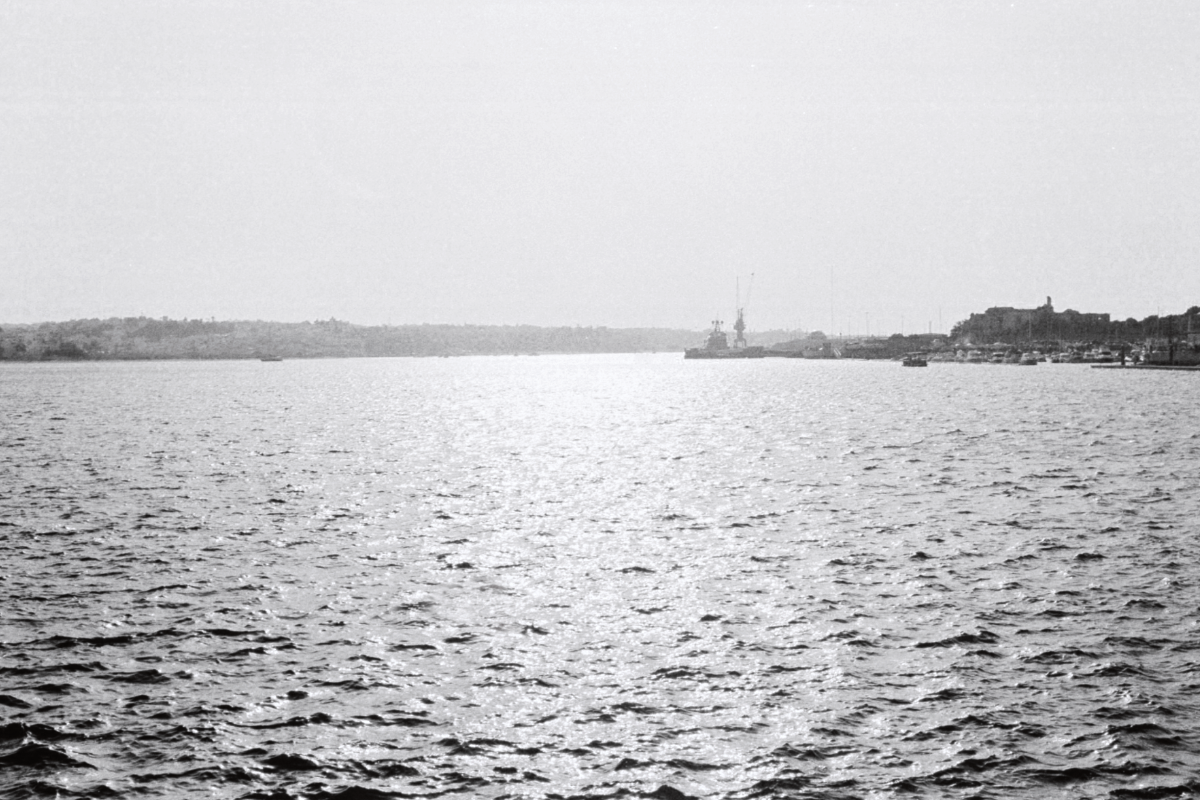
I am looking at one now. It shows a wide expanse of water. Somewhere in the distance there is a coastline, little more than a pale strip approaching the horizon. On the right, a few structures interrupt the shoreline. Near the centre there appears to be a vessel, although distance and atmosphere have reduced it almost to a silhouette. That is about all. At first sight, it could be anywhere. And perhaps that is precisely why I keep looking.
What do I actually see?
When I look at a photograph carefully, I try to separate seeing from recognising. Recognition happens quickly. Water, coast, boat, sky. Within seconds my brain has classified the important elements and could comfortably move on to the next photograph. There is apparently no mystery left to solve. But seeing is something different. Seeing requires time. The longer I remain with this image, the less important its identifiable objects become. I stop looking at the boat as a boat and the coastline as a coastline. Instead, I begin to notice distances. Empty spaces. Tonal differences. The enormous area occupied by water and sky. The almost hesitant way in which the land appears in the distance.
The photograph begins to change. Or rather, I begin to change while looking at it. What initially seemed almost insignificant starts to acquire weight. There is no spectacular sunset. No dramatic cloud formation. No person standing in the foreground to give the landscape an obvious human meaning. There is nothing that tells me how I am supposed to feel. That absence leaves space. And into that space, almost inevitably, I begin to bring something of myself.
Arrival or departure?
The water appears calm. Not perfectly still, but calm enough that movement seems secondary to atmosphere. The light is subdued. There is brightness, but little brilliance. The distant shore seems to dissolve slightly into the air. Everything feels quiet. Introverted. That word keeps returning to me. The photograph does not seem to reach outward. It seems to withdraw. Even the horizon refuses to establish itself strongly. Nothing demands attention. Nothing competes to become the obvious subject.
And yet I begin to wonder: am I arriving somewhere, or am I leaving? It is a simple question, but once it enters my mind, the photograph becomes something else entirely. If I am arriving, the distant coastline is a destination. Somewhere beyond that water there may be streets, houses, people, conversations, unfamiliar rooms. The vague shapes on the horizon become a promise. But if I am leaving, the same coastline becomes a memory. The distance then means separation. The boat, the shore and the fading land acquire an entirely different emotional charge without anything in the photograph itself having changed. Perhaps that is part of the expressive power of photography. A photograph can remain physically identical while becoming psychologically unstable. Its meaning can move.
The significance of what seems insignificant
I sometimes think we have become too accustomed to asking photographs to perform. They must be sharp. Striking. Beautiful. Technically impressive. Immediately understandable. On a screen, surrounded by hundreds or thousands of other images, a photograph is given only a fraction of a second to justify its existence. But some photographs refuse that competition. They whisper.
At first, this photograph of water might appear almost empty. If I encountered it while quickly scrolling through images, I might pass it without hesitation. Yet when I stop, its apparent emptiness becomes its strength. The absence of an obvious event makes me aware of something photography can do particularly well: preserve a state of being rather than merely record an event. Nothing needs to happen. Perhaps nothing did happen. Someone stood somewhere, looked across this water and decided that this moment was worth preserving. That decision fascinates me.
Why did the photographer press the shutter?
Eventually I stop asking what the photograph shows and start asking what the photographer saw. Why this view? Why this moment? What made him lift the camera? Perhaps he was travelling. Perhaps he had just arrived. Perhaps he was about to leave. Perhaps this coastline meant something deeply personal to him. Or perhaps it meant nothing at all until that particular combination of light, distance and silence suddenly caught his attention. I cannot know. And I do not really want to invent an answer. The uncertainty is more interesting.
I wonder what he was thinking when he made the exposure. Was he consciously composing a photograph about distance? Was he attracted by the subdued light? Did he notice the way the coastline almost disappeared? Did he wait for the vessel to reach that particular position? Or was the photograph made intuitively, before any of those thoughts had been put into words? Photography often works that way for me. I can recognise something visually before I understand why it matters. The camera sometimes responds before language does. Only later does the question arise: Why did I photograph that?
Sharpness is not always clarity
Technically, this photograph does not force itself upon me either. The distant landscape is vague. Details disappear. The horizon does not cut sharply through the frame. The atmosphere seems to soften everything that lies far away. I assume this is important. Whether every aspect of that softness was deliberately controlled by the photographer is impossible for me to know, but within the photograph it feels right. Greater sharpness would provide more information, yet I am not convinced that more information would produce a stronger image. Perhaps the opposite.
If every distant building, mast and contour were perfectly defined, I might start examining them as objects. I would ask where this was, what kind of ship I was seeing, what stood on the shore. The photograph would become more descriptive. Instead, its lack of precise detail pushes me inward. The uncertainty becomes emotional rather than technical. Sharpness, after all, is not the same thing as clarity of expression. Sometimes what a photograph leaves unresolved is exactly what gives it its voice.
What was he feeling?
This may be the question that intrigues me most. What were the photographer’s emotions at that moment? Melancholy? Peace? Expectation? Loneliness? Relief? Perhaps none of them. A photograph is dangerous in this respect because it tempts me to confuse my own emotions with those of its maker. The silence I experience may not have been his silence. The melancholy I sense may exist entirely within me. And that realisation makes the photograph more interesting, not less.
The photographer gives me a frame. Inside that frame are light, water, distance and time. But the emotional meaning is not sealed inside the negative waiting to be extracted. It emerges somewhere between the photograph and the person looking at it. Between him and me. Perhaps that is where the true expressive power of a photograph resides.
Why does this photograph hold me?
I return to my original question. Why does this photograph fascinate me? Not because of what it shows. There are countless photographs of water, coastlines and distant ships. Not because it demonstrates technical perfection. Not because something extraordinary is happening. It fascinates me because it leaves something unfinished. It gives me enough to enter, but not enough to arrive at a conclusion.
The longer I look, the more the physical landscape becomes an inner landscape. The water becomes distance. The coastline becomes possibility. The subdued light becomes memory. Arrival and departure begin to exist simultaneously. And gradually I stop wondering where this photograph was made. That no longer seems important. I am more interested in the strange transition that has taken place while I have been looking at it. A photograph that initially appeared almost insignificant has made me quiet. It has slowed me down. It has caused me to turn inward and ask questions for which the image provides no answers.
Perhaps that is enough. Perhaps the expressive power of a photograph cannot always be measured by how clearly it tells us something. Sometimes its power lies in what it refuses to explain. A photograph does not necessarily have to say: Look at this. Sometimes it simply says: Stay a little longer. And when I do, I may discover that I am no longer only looking at the photograph. I am looking at myself.