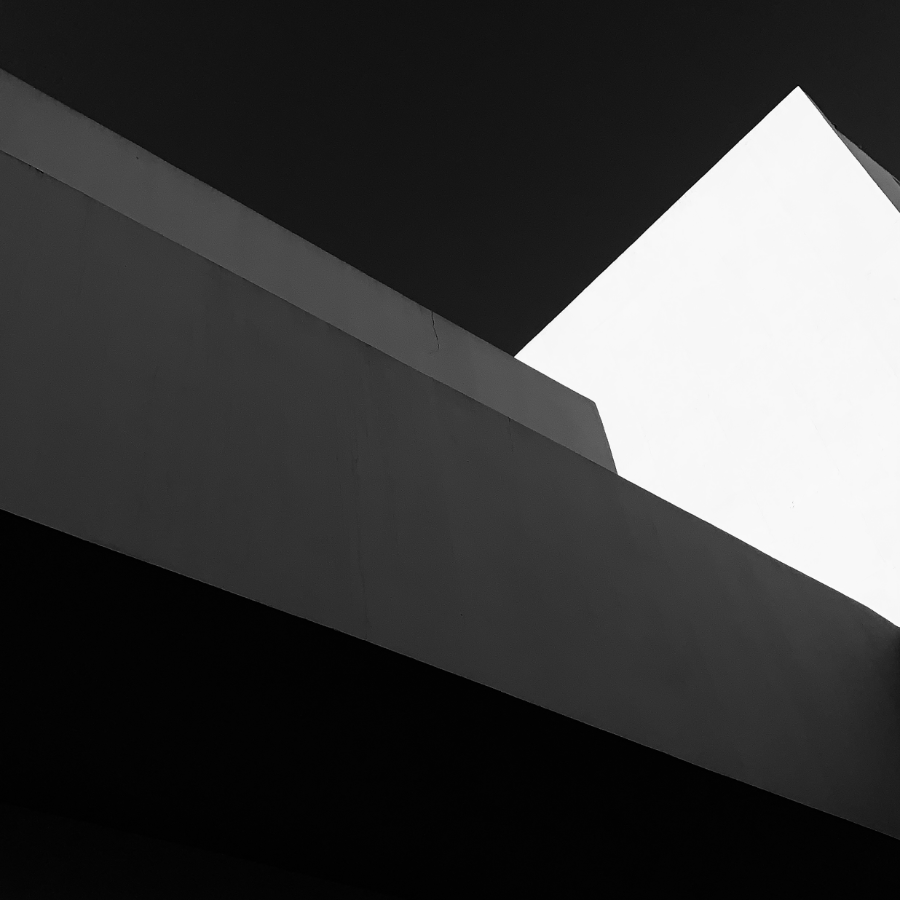
Abstract photography does not necessarily begin with an abstract subject. Sometimes it begins with a wall, a shadow, and a moment in which the familiar suddenly stops looking familiar. A sudden shift in how we see the ordinary.
There was nothing remarkable about the wall. It was part of a balcony, with the façade of another building rising behind it. Architecture of the kind we encounter every day and usually ignore. Walls, edges, corners, concrete surfaces. Things that exist because they have a practical purpose, not because they are asking to be photographed. I could easily have walked past it without giving it another thought, but the light had changed everything. At that particular moment, sunlight struck part of the building with an intensity that separated it from its surroundings. One surface became almost white, another remained grey, while the deepest areas disappeared into black. The architecture was still there, but its function had become irrelevant. I was no longer looking at a balcony wall and a neighbouring building. I was looking at triangles, rectangles, diagonals, areas of light and darkness, and the tension between them. That transformation is what fascinates me about abstract photography. For me, abstraction in photography is not primarily about photographing strange things. It is about seeing ordinary things differently.
The moment an object stops being an object
Photography has an unusually strong relationship with reality. A photograph begins with something that was physically present in front of the camera. Light reflected from an object, entered the lens and formed an image. However much we manipulate composition, exposure or focus, there is usually something on the other side of the camera that actually existed. That makes abstraction particularly interesting. A painter can begin with an empty canvas and invent forms that have no counterpart in the physical world. A photographer normally begins with the world itself. Abstraction therefore requires a different process: I have to find another image inside the visible world. The balcony wall in this photograph did not cease to be a wall when I photographed it. Yet that is no longer the most important thing about it. Its identity has been pushed into the background. What remains is geometry.
A large black field occupies much of the frame. A brilliant white triangular form enters from the right. Between them are different shades of grey, crossed by strong diagonal lines. Rectangles and triangles overlap without quite becoming regular geometric figures. Some lines lead towards one another, others seem to resist each other. There is weight at the bottom of the frame and openness above it. The brightest shape appears almost detached from the building that created it. The photograph still contains architecture, but I am no longer asking the viewer to look at architecture. I am asking the viewer to look at relationships. Light against darkness. A diagonal against a vertical. A small grey plane against a large black one. A sharp edge against an apparently empty space. That, to me, is where abstraction begins.
Learning to distrust the obvious
One of the most useful things photography has taught me is not always to accept the first description of what I see. A wall is a wall. A staircase is a staircase. A window is a window. A shadow is a shadow. Those descriptions are useful when I need to navigate the physical world, but they can become an obstacle when I am photographing it. The moment I decide that something is merely a wall, I have already reduced the number of ways in which I can see it. Abstract photography asks me to suspend that recognition for a moment. Instead of asking what is it?, I can ask different questions. Where does the light begin? Where does the line end? What happens when these two shapes touch? What happens if I exclude the surrounding building? Is the shadow merely an absence of light, or can it become a shape in its own right? This change sounds simple, but I find it surprisingly difficult. We are exceptionally good at recognising objects. We need to be. The mind constantly identifies and categorises what the eyes encounter. Door, car, face, tree, building, road. The photographer has to do something slightly unnatural: recognise the object and then, forget what it is and what it was made for. Only then can a wall become a collection of planes.
Light as transformation
The subject of this photograph existed before the photograph, but the image itself existed only briefly. Without that particular light, I doubt that I would have photographed the wall at all. This is important to me because it means that abstract photography is not necessarily about imposing something artificial on reality. Sometimes reality itself performs the transformation. Light does not merely illuminate objects. It reorganises them. A surface that appears flat under diffuse light can suddenly acquire depth when illuminated from an angle. A minor architectural detail can become dominant. A shadow can remove information just as effectively as light can reveal it. Two adjacent surfaces that normally look almost identical can suddenly separate into completely different tonal fields.
In this photograph, the light has simplified the building. That simplification is essential. Details disappear into darkness. Texture becomes secondary. The brightest area loses much of its material character and approaches pure white. The photograph begins to move away from a description of a building and towards an arrangement of tonal masses. The strongest light does something else as well: it creates the visual anchor of the image. My eye is drawn immediately towards that brilliant triangular area, but it cannot remain there. The diagonals send it elsewhere. I begin to move through the photograph. That movement is one of the qualities I look for in an abstract composition. I do not want the eye simply to identify a subject and stop. I want it to explore.
Geometry found rather than constructed
There is a temptation to associate geometric abstraction with perfect order: immaculate lines, exact symmetry, carefully calculated proportions. That is not what interests me most. I prefer geometry that has been discovered. The lines in this photograph were designed by architects and builders for entirely practical reasons. They were never intended to form the composition I saw. The composition exists because of my position, the direction in which I pointed the camera, the boundaries of the frame and, above all, the light at that particular moment. Move a few steps and the relationship changes. Wait an hour and the light changes. Return on an overcast day and the photograph might never have existed. This makes the process strangely exciting. I am not creating the physical elements, yet I am responsible for recognising the moment when they come together. The camera frame then becomes decisive. Photography is as much an art of exclusion as inclusion. Outside this photograph there is more building, more balcony, probably countless visual clues explaining exactly what we are looking at. I chose not to show them. By removing context, I remove certainty. And when certainty disappears, another kind of seeing becomes possible.
A new reality inside the old one
This is perhaps the part of abstract photography that fascinates me most. The photographer does not simply record reality. For a fraction of a second, he can discover another reality within it. I do not mean that in a mystical sense. Everything in the photograph was physically present. Nothing had to be invented. Yet the image created by selecting these particular relationships did not exist in quite the same way until it was seen. First I had to recognise it. Then I had to photograph it. The photograph becomes evidence of that act of seeing — a photographic testimony that says: for one moment, this is how the world appeared to me. That places a responsibility on the photographer. Seeing something unusual is not enough. I still have to translate that experience into an image capable of surviving independently of the moment in which I experienced it. The viewer was not standing where I stood. The viewer did not see the ordinary balcony before the light transformed it. There is no memory of the seconds before I raised the camera. There is only the photograph. The composition therefore has to carry the experience. If it works, the viewer does not need to know immediately that these shapes belong to a balcony wall and the façade of another building. In fact, I rather like the possibility that this information arrives later. First comes the image. Then comes recognition. And perhaps, after recognition, the image changes again.
Abstraction does not require obscurity
I do not think an abstract photograph has to be incomprehensible. There is a difference between ambiguity and confusion. I am interested in photographs that give the eye enough information to become engaged, while withholding enough information to prevent immediate closure. The viewer may suspect architecture here. Someone else might see folded planes, a fragment of a modernist painting, or simply an arrangement of black, white and grey. None of those reactions troubles me. Once the photograph exists, the viewer brings something to it that I cannot control — memory, association, preference, emotion. My task is not to prescribe exactly what must be seen or felt. My task is to make the visual relationships strong enough to invite attention. That emotional response matters. Abstract photography can sometimes be discussed as though it were purely formal: line, shape, colour, texture, rhythm, repetition. Those are its vocabulary, but they are not necessarily its destination. A black area can feel heavy. A diagonal can introduce instability. A narrow strip of light can create tension. An isolated form can suggest silence. We respond emotionally to visual structure even when there is no conventional narrative. Perhaps especially then.
The ordinary as raw material
I find this liberating because it means that abstract photography does not require extraordinary locations. I do not need dramatic mountains, famous architecture or exotic streets. I do not even need to go looking specifically for an abstract subject. The raw material is everywhere. A reflection in a window. Painted markings on asphalt. Light falling across a curtain. The edge of a table. Shadows on concrete. A fragment of a staircase. Layers of glass. A coloured wall intersected by another surface. Most of these things are visually invisible to us precisely because they are so familiar. And that is the challenge. Can I look at something I have seen a hundred times and, on the hundred-and-first occasion, discover something different? For me, that question reaches beyond abstract photography. It touches the essence of photography itself. The camera does not automatically make the world interesting. The photographer has to pay attention.
Waiting for the ordinary to change
When I look at this photograph now, I know what is actually in it. I know that the dramatic geometry is nothing more exotic than a balcony wall and part of a neighbouring façade. But that knowledge does not diminish the photograph for me. It strengthens it. The extraordinary thing is precisely that the original subject was so ordinary. Nothing was built for the photograph. Nothing was arranged. The architecture was simply there, probably unnoticed by almost everyone who passed it. Then the light arrived at the right angle and, for a short time, changed the visual order of things. The wall became brighter, the shadows became deeper, the lines became stronger, the shapes separated. And suddenly there was a photograph. That is what abstract photography means to me: not escaping reality, but looking at it closely enough for another reality to emerge. The world does not always need to provide us with new subjects. Sometimes we simply need to see the ordinary differently.